What I actually look for in a business class redemption
People ask me all the time how I decide whether a redemption is worth it. The honest answer is that it comes down to a small number of principles I've developed over years of booking — and one rule I almost never break.
This isn't a technical guide to award programs. It's the actual framework I use when I sit down to search — the order I think in, the trade-offs I'm willing to make, and the ones I'm not. If you've ever stared at a points balance wondering whether to pull the trigger, this is the post for you.
The first thing I look at: points cost and fees.
Before anything else — before the airline, before the cabin, before the routing — I look at the total cost in points and the taxes and fees in cash. Both numbers matter. A redemption that looks cheap in points but charges $600 in fees is a very different proposition to one that costs slightly more points but only $250 out of pocket.
My baseline rule is simple: I want at least 2 cents of value for every point I spend. That's the threshold below which a redemption stops feeling like a win and starts feeling like a consolation prize.
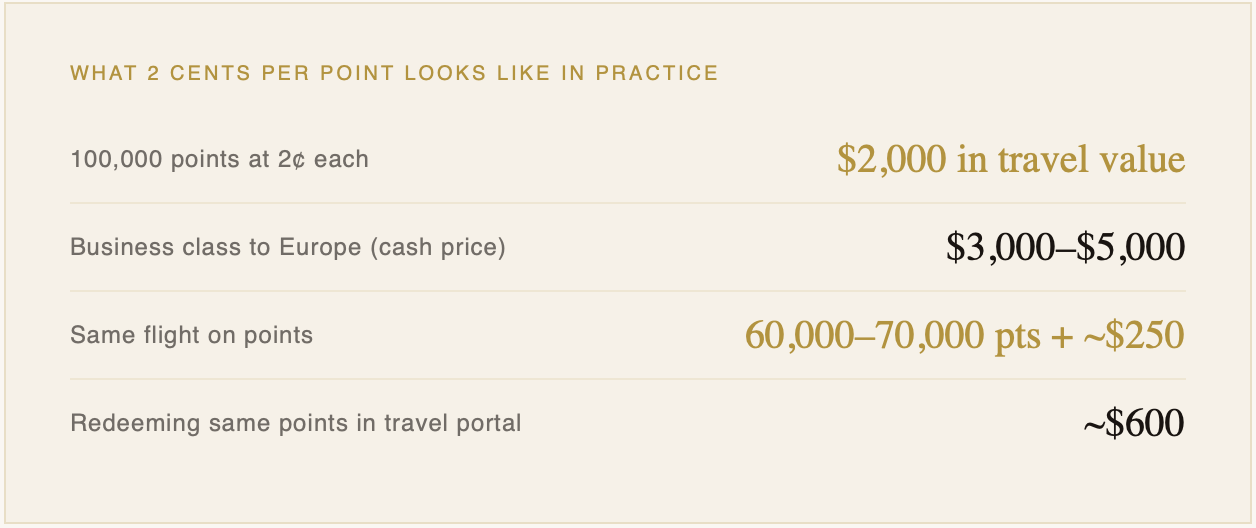
Think about what that actually means. You have 70,000 Amex points. You could redeem them through the portal for roughly $600 toward a flight. Or you could transfer them to Air France Flying Blue and book a lay-flat business class seat to Paris for a flight that costs $3,000 in cash. The points are the same. The experience is completely different. That gap — between what points are worth in a portal versus what they unlock through a transfer — is the entire premise of doing this properly.
I have broken the 2 cent rule, but only on low-value redemptions. Sometimes I don't want to pay $200 for a domestic economy flight, so I'll use 15,000–20,000 points to cover it instead. The value isn't as strong, but it's not many points lost and it keeps cash in my pocket. The rule exists for big redemptions — long-haul business class, premium hotels — where the gap between portal value and transfer value is enormous.
Airport flexibility is one of the most underused tools in points travel.
I'm based in Phoenix. Phoenix Sky Harbor is a fine airport, but it doesn't have a wide range of direct long-haul options and my choices in business class are limited compared to Los Angeles, San Francisco, or Dallas. So I don't limit myself to Phoenix.
For any meaningful redemption, I'll fly a cheap connection — usually under $200 — to a major hub and pick up the business class flight from there. I'd rather pay $150 to get to LAX and fly business class for 16 hours than leave from Phoenix and compromise on the cabin or the carrier.
A good example: Emirates doesn't fly from Phoenix. By repositioning to Los Angeles, I was able to book LAX–DXB–JNB on Emirates — a routing that simply wouldn't have existed if I'd anchored myself to my home airport. The $150 connection to LA was irrelevant against the value of the redemption.
“I’d rather pay $150 to reposition to LA and fly business class for 16 hours than leave from Phoenix and compromise on the cabin.”
Which airlines I book — and which I avoid.
I have preferences, and I have hard passes. Life is too short and points are too valuable to spend on a subpar product.
Ethiopian Airlines and Air India are two I avoid entirely. The product isn't at the standard I look for, and Air India has a safety record that gives me genuine pause. When you're spending significant points on a long-haul redemption, you want an airline whose business class is actually worth the cost — and whose operational standards you trust completely.
Layovers aren't always a problem. Sometimes they're the point.
I prefer direct flights where possible. But when a connection is inevitable — or when it unlocks a routing that wouldn't otherwise exist — the layover airport matters enormously. There's a significant difference between a three-hour connection in a forgettable mid-tier airport and the same connection in Dubai, Singapore, Doha, Paris, or Taipei.
These airports have exceptional lounges, great food, and facilities that make a layover feel like a bonus rather than a nuisance. A three-hour stopover in Doha's Al Mourjan lounge before boarding Qatar QSuites is not a hardship. It's part of the experience.
The Emirates redemption I still think about.
The most expensive redemption I've made — in the sense of questioning its relative value — was Emirates from LAX to Johannesburg via Dubai. It cost 157,000 points and $1,250 in fees. The business class on the A380 was genuinely incredible. We had a free stopover in Dubai. On the DXB–JNB leg we were able to upgrade to first class. As an experience, it delivered everything I hoped for.
158k
Emirates LAX-DXB-JNB
Points 158,500 — Fees: $1,250 — Cabin: Business / First upgrade DXB-JNB
But Qatar Airways would have covered the same routing for around 95,000 points and $250. The cash savings alone were over $1,000. Looking back, I stand by the decision — the Emirates A380 product was worth experiencing, Dubai was worth the stopover, and I didn't know then what I know now about how Emirates would devalue its program. But it's not a redemption I'd repeat. Qatar's QSuites is the better product at a fraction of the points cost.
When to search — and why timing is everything.
Award availability follows a pattern that most people don't know about. The best windows are either twelve months out, when airlines first release their award inventory, or within a few months of the travel date, when unsold seats get opened up for points redemptions.
The dead zone is roughly six to eleven months before departure. Airlines aren't motivated to release premium seats for points redemption yet — they're still hoping to sell them for cash. Searching in that window is where most people get frustrated and give up. The availability is genuinely harder to find and the prices when you do find seats are often higher.
The single most important thing I've learned — and the thing I tell everyone I work with — is this: be flexible, be patient, and just go for it.
I've worked with people who were hesitant to reposition to a different airport, to deal with a longer layover, to book dates that weren't their first choice. Every single one of them, once they did it, couldn't wait to do it again. The flexibility is what makes the whole thing work. It isn't a compromise — it's the strategy.
The seat is waiting. You just have to be willing to find it.